What Makes a Game Executive-Function-Building?
By Makena Wood, B.Sc. Neuroscience
Have you ever wondered how we choose which games to include in our curriculums? While all kinds of play improve executive function (EF), there are specific reasons why we’ve promoted each of our games as EF-building. If you’ve used any of our curriculums before, then you know that with each game comes a “What you learn” section attached that explains which of your EF skills are being exercised while playing the game. If you need a refresher on EF, you can read one of our recent blogs, “Understanding Executive Functions”, found here: https://www.buildingbrains.ca/blog/understanding-executive-functions
Briefly, EFs are developed in early childhood and adolescence and are housed in the prefrontal cortex of the brain. There are three core EFs: Working Memory, Inhibitory Control, and Cognitive Flexibility. Alongside these, motor and spatial skills and emotional regulation are also functions of the prefrontal cortex.
- Working Memory (WM) is the ability to hold in mind and mentally manipulate information.
- Inhibitory Control (IC) is the ability to control personal attention, behaviour, thoughts, and emotions to prevent distractions.
- Cognitive Flexibility (CF) is the ability to try new approaches to a problem, take on new perspectives, adjust to new demands or priorities, and/or switch between tasks.
Therefore, games that exercise WM, IC, and CF can be called EF-building games. Below is a list of types of games, along with examples from our curriculum, that exercise EF.
1. Physical Activity Games
Physical Activity Games can be broadly defined as games that involve movement. In their review of the effects of physical activity games on EF in children and adolescents, J. Wang et al. (2024) separate physical activity games into aerobic exercise, ball games, cognitively engaging physical activity, dance, and high-intensity interval training. The physical activity games found in the BBT curriculums used in this study fall into the categories of ball games (involving rapid action decisions to catch or throw a ball) and cognitively engaging physical activity (games that require attention and focus to select correct actions). In the review by J. Wang et al., the improvement of EFs by physical activity was supported, with some types of games showing greater efficacy at improving respective components of EF (WM, CF, and IC). Notably, ball games were found to be most beneficial for WM, while cognitively engaging physical activity was found to be most beneficial for IC. There were no selective advantages across the physical activity game types for improving CF.
Examples of physical activity games from BBT curriculums: Apple Orange Banana, Dodgeball, Balloon Volleyball, Rock Paper Scissors Tag, Simon Says, Musical Freeze, Red Light Green Light
2. Memory Games
Memory games are a type of cognitively engaging game that require players to recall and hold information relevant to the goal of the game in mind during play and manipulate this information throughout game play. For example, the physical activity game Apple Orange Banana is also a memory game because players are required to remember which actions correspond to which fruits and manipulate this information to invoke motor responses during game play. If players are not successful in remembering this information, they will not achieve the goal of the game. In contrast, physical activity games like Balloon Volleyball or Blindfold Lego do not require memory recall of facts (other than the rules of the game, which is common to every game) to achieve the goal. The mental manipulation of information and updating are cornerstones of WM, but many memory games also simultaneously train inhibition (e.g., inhibiting incorrect responses) and CF (e.g., shifting when the category changes).
Examples of memory games from BBT curriculums: Concentration, One Word Story, Guess This Song
3. Word Games
Word games are defined as any game whose goal requires the manipulation of letters or language. For example, the memory game One Word Story is also a work game because it requires the use and manipulation of language to achieve the goal of the game (to create the longest coherent story possible). On the other hand, Concentration is not a word game because it does not require the players to manipulate language to achieve the goal. Language has a natural relationship with EF, but it is difficult to discern the directionality of the relationship in existing literature (Shokrkon & Nicoladis, 2022). Nonetheless, it is theorized that practicing language skills can support the development of EF (Shokrkon & Nicoladis, 2022).
Examples of word game from BBT curriculums: Name Place Animal Object, Association
4. Problem-Solving Games
Problem-solving games are defined as any game that requires troubleshooting, trial-and-error, and adjusting with feedback to achieve the goal. Problem solving games are similar to memory games because they require the manipulation of information relevant to the goal of the game, but unlike memory games they do not require the player to recall any information that is not otherwise available to them. Further, in memory games players are given all the information they need at the beginning of the game (and must recall this information), whereas in problem solving games, players acquire new information throughout the game. To solve a problem, which can be defined as having a goal but not a procedure, both creativity and EF are required (Alescio-Lautier et al., 2023). In problem solving games, a player who has played the game more than once will have a general understanding of their preferred procedure, but this procedure will still have to be altered as the goal of the game changes with each new attempt. Problem-solving training, more specific but not dissimilar to playing problem solving games, has been shown to encourage increased recruitment of CF during innovative thinking (Alescio-Lautier et al., 2023).
Examples of problem solving games from BBT curriculums: Whiteboard Wordle, Codemasters, Charades, Shared Project
5. Card Games
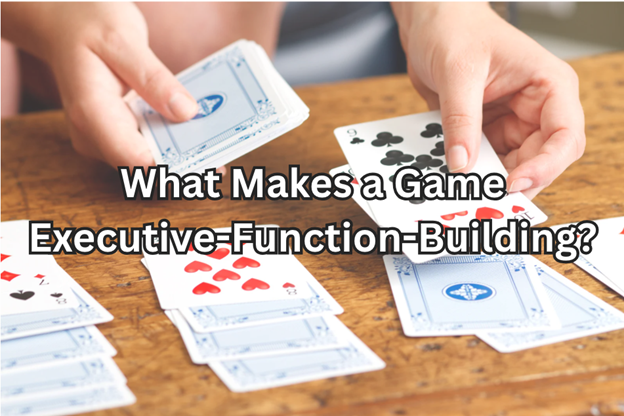
Card games are defined as any style of game that has players use playing cards to achieve the goal of the game. Unlike other types of games described so far, card games have materials that introduce new information to the game. In contrast, the playing materials of other games, like the whiteboard and markers in Wordle, are essential to gameplay but do not themselves change the trajectory of the game. When the materials of the game determine its direction, the mechanism involved can be referred to as “reveal and react”, which is common to many board and card games and specifically targets rapid decision-making, attentional control, and WM updating (Charifa & Apriliani, 2025). It is suggested that IC is most strongly supported because of the frequent and rapid shifts in attention accompanied by changing rules in reveal-and-react games (Charifa & Apriliani, 2025). Importantly, a 2023 randomized controlled trial by Moya-Higueras et al. found that modern card games were equally as effective as games designed to activate EFs in producing EF gains in children at risk for social exclusion (Moya-Higueras et al., 2023). Therefore, it is suggested that card games are inherently beneficial for EF, regardless of whether they seek to activate specific EFs or not.
Examples of card games from BBT curriculums: Slap, Cheat, Spoons, Oh Heck!
There are many other types of games that also serve to build EFs than have been mentioned above. The above categories capture a majority of the types of games that are included in the BBT 0-10, Adolescent, and Older Adult curriculums.
For more information about our curriculums or to download the games for yourself, visit our Resource pages:
https://www.buildingbrains.ca/children
https://www.buildingbrains.ca/adolescents
buildingbrains.ca/older-adults
References
Alescio-Lautier, B., Chambon, C., Deshayes, C., Anton, J.-L., Escoffier, G., Ferrer, M.-H., & Paban, V. (2023). Problem-solving training modifies cognitive functioning and related functional connectivity in healthy adults. Neuropsychological Rehabilitation, 33(1), 103–138. https://doi.org/10.1080/09602011.2021.1987277
Charifa, P., & Apriliani, I. (2025). Playing to focus: A systematic review of reveal-and-react board and card games for executive function development in children. Bulletin of Counseling and Psychotherapy, 7(2). https://doi.org/10.51214/002025071524000
Moya-Higueras, J., Solé-Puiggené, M., Vita-Barrull, N., Estrada-Plana, V., Guzman, N., Arias, S., Garcia, X., Ayesa-Arriola, R., & March-Llanes, J. (2023). Just play cognitive modern board and card games, it’s going to be good for your executive functions: A randomized controlled trial with children at risk of social exclusion. Children, 10(9), 1492. https://doi.org/10.3390/children10091492
Shokrkon, A., & Nicoladis, E. (2022). The directionality of the relationship between executive functions and language skills: A literature review. Frontiers in Psychology, 13, 848696. https://doi.org/10.3389/fpsyg.2022.848696
Wang, J., Yang, Y., Li, L., Yang, X., Guo, X., Yuan, X., Xie, T., Yang, K., & Zhuang, J. (2024). Comparative efficacy of physical activity types on executive functions in children and adolescents: A network meta-analysis of randomized controlled trials. Journal of Science and Medicine in Sport, 27(3), 187–196. https://doi.org/10.1016/j.jsams.2023.11.006