By Makena Wood, B.Sc. Neuroscience
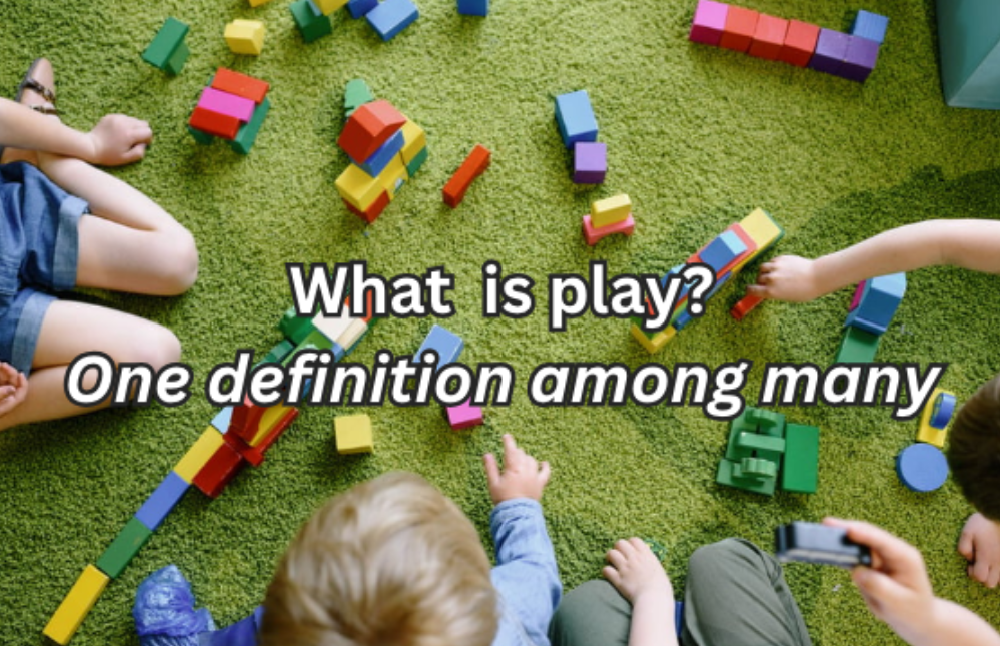
When you think of play, what comes to mind? Likely, images of fun, laughter, conversation, freedom, and youthfulness come to mind. Play can be all of these things, and more. Most importantly, play is not a limited or exclusive concept. Play is for everyone and, often, play is in the eye of the beholder. Research into play has struggled to create a single, all-encompassing definition for play that can directly answer the question: What is play? In this blog, I will cover some of the important features of play that have been developed in scientific literature and connect these features to Building Brains Together (BBT)’s definition of play.
Play Research
Play is a complex concept to define1,2. While there is a broad base of play literature (searching the keyword ‘play’ in the PubMed database yields 966,497 results) that includes everything from the evolution of play behaviour in animals to the developmental implications of play in humans, the one thing that authors can agree on is that there is not a singular, all-encompassing definition of play. This blog will not be able to provide that definition, but it will describe a definition that BBT uses for the purposes of building adult capabilities to improve brain development and executive functions.
Based on a review of play literature2, the most salient features of play are:
Play is done for its own sake
Play is intrinsically motivated (individuals play because they want to)
Play is free and voluntary
Play produces positive feelings
However, in the review these authors discuss that current definitions of play are broad, and even filled with opposites, which makes it difficult to connect play to specific learning outcomes. For example, the learning outcomes of free play (or child-directed play) are much different than the outcomes for guided play (e.g., games with rules)2. Understanding play as a spectrum of behaviours, goals, desires, and outcomes can be useful to recognize the unique contributions that different types of play have to offer.
Games
While searching the BBT website for ways to play will lead you to many different kinds, the primary focus of our work has been games. Games are a type of play that are guided, rule-based, and often goal-based. Games are one type of play that has received further attention from researchers.
A review of definitions for “game” provides us with select qualities that also fit the description of BBT curriculum games3:
Games have rules: in general, there is no game without its rules.
Games do not serve a function or purpose: games are unproductive and a means to their own end; they do not serve a function but can have a purpose, which is different than a goal
Games have players: there is no game without players.
Games have competition and conflict: competition can exist between adversaries or by achieving the objective of the game in a challenging context.
Games have goals and end-conditions: a goal is what differentiates games from open-ended play (or free play); there is usually a sense of playing to win or achieve something.
Games are their own category of play: these characteristics distinguish games from other neighboring types of play, like sports or puzzles.
By taking these characteristics of games one at a time, we can begin to see how games help support brain development by the skills required to play a game, even without the rigorous data that support the use of play and games to build executive function. When individuals play games, they are learning to follow rules, to regulate their emotions and shift from work to play, to collaborate with others, to manage intense feelings like frustration, to respectfully conflict with others, to pay attention, and to problem-solve.
BBT’s definition of play
With all of this in mind, we can return to BBT’s mission and vision to establish a definition for play centered on brain development, executive function, and inclusivity.
BBT’s mission is to build adult capabilities to improve brain development and executive function across the lifespan through play supported by research and education, and our vision is a healthy, resilient society. Here’s how play fits in:
→ Play is an opportunity for fun, growth, positive stress, and relationship-building that is freely chosen and pursued for its own sake in all types of spaces and by all types of people across the lifespan.
You, the adult reading this blog, are building your supportive capabilities by learning about what it means to play. Most importantly, each time you take the time to play or encourage others to play, you are forging strong and positive relationships and contributing to a healthy, resilient society.
References
Yogman, M., Garner, A., Hutchinson, J., Hirsh-Pasek, K., & Michnick Golinkoff, R.(2018). The power of play: A pediatric role in enhancing development in young children. Pediatrics, 142(3), e20182058. https://doi.org/10.1542/peds.2018-2058
Zosh, J. M., Hirsh-Pasek, K., Hopkins, E. J., Jensen, H., Liu, C., Neale, D., Lynneth Solis, S., & Whitebread, D. (2018). Accessing the inaccessible: Redefining play as a spectrum. Frontiers in Psychology, 9, 1124. https://doi.org/10.3389/fpsyg.2018.01124
Stenros, J. (2017). The game definition game: A review. Games and Culture, 12(6), 499–520. https://doi.org/10.1177/1555412016655679