Traditional Games of Zimbabwe
With Tadiwanashe Natasha Matemera

“Zimbabwe is named after the Great Zimbabwe of the Rozwi Shona dynasty” [13]. The country is comprised primarily of the Shona people (80%), followed by the Ndebele, and smaller groups of Tonga, Shangaan and Venda who all share similar beliefs in aspects of marriage and their supernatural ancestors [13,14]. Tadiwanashe Natasha Matemera is from the Shona people of Zimbabwe.
Traditional games Mitambo Yechinyakare are often played at social gatherings and celebrations. This is part of the rich culture and heritage of Zimbabwe. People of all ages play for enjoyment while acknowledging the importance of play. Games are also played with changes to the rules to make games more challenging or more fun depending on the situation [1].
Global Press Journal 2021
Through numerous and varied games, Shona children learn issues of negotiation and cooperation, skills for evasion, skills for quick problem solving, and skills for singing and dancing. The various skills acquired greatly contribute to their daily survival and communal harmonization while maintaining cultural continuity [5].
Hand-Clapping Games: Mitambo Yokuombera Maoko
Children of various ages play hand-clapping games and will play more advanced versions as they grow and learn [2]. “Playing hand-clapping games while singing songs promotes physical and musical coordination as they are challenged to sing in one rhythm but move their hands and arms in a different rhythm” [2]. It is also a way to communicate through storytelling where the rhythm and pace will change throughout the events of a story [3].
“The first two games are hand-clapping games and are very easy”.
Game 1
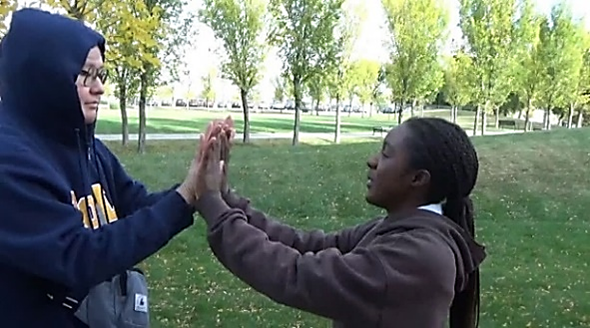
“It’s just like one method going over and over and over again. So, we go like this- back hands clap “am” front hands clap “Mena” and then we clap our own hands three times. “amena kadeha” clap three times, “simone ya”, clap three times,
“Amena one, sa, teo, po, smata, keh, smata keh, ats go beh, beh, beh tagma beh, beh, beh, hatamina shop” while clapping back front-back-front-back-front.
“And we continue clapping each other’s hands on a loop until the song ends, and somebody stops it by saying Shop. Then we show our thumbs up for the end”.
Game 2
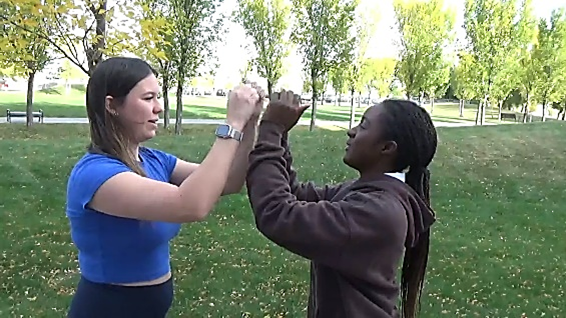
“This one is like really fun. I think I’ve seen variations of this one after I moved here. So it goes, two claps of fists with each player, then two claps forward, two claps of fists, two claps of hands backward, two claps of hands of forward, two claps of hands backward, two claps of fists one clap hands forward, one clap hands backward.
“Double, double, this this Double, double. That, that. Double, this. Double, that. Double, double this and that”.
Hand clapping is integral with a rich tradition of respect in the Shona culture, which has always been a core element of the people in Zimbabwe as mutual respect among a society binds communities together [3]. Hand clapping was used to exchange greetings, after a kind gesture, prior to accepting gifts, and for celebrations of weddings and funerals. Men clap lengthwise with their hands cupped, whereas women clap sideways with hands cupped, producing a shallow sound. Clapping was also used in traditional courts during meetings of village elders or kingdom chiefs. A series of clapping was performed before approaching the bench [3].
The combination of motor and language skills for coordinating actions of clapping and singing are developed through continual monitoring and updating of activities to maintain song lyrics with different clapping patterns. Heightened attention to various rhythms utilizes executive functions of working memory, monitoring, inhibition, planning and organization for the temporal sequencing and spatial awareness of a series of movements necessary to maintain the rhythms with a partner. Hand clapping games and singing have always been considered a great way to promote cognitive flexibility [7].
Nhodo
“This game is called Nhodo”. The Shona people of Zimbabwe play Nhodo, which means ‘to take’ in the Shona language and ‘to grab’ in other languages. Other variations of this game exist with similar rules and mechanics [1].
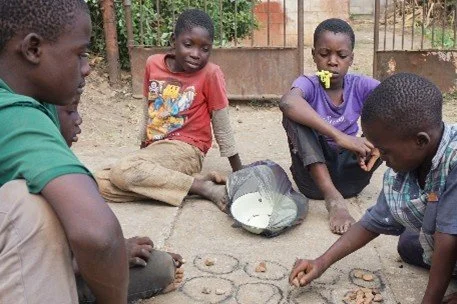
“Some of the games are just for young girls and it’s when I started to play this game. It’s a good game to train your hand eye coordination. The most basic version of this game will have each person collect ten pebbles for themselves. Each person also needs a bigger stone. Preferably, one that is round and smooth shaped because you are throwing it in the air and grabbing it. They are called mwana in Shona, which is my language. And mwana in Shona is ‘babies or children’ in English. So, they are like your babies. And then this one is your mother stone. It’s called amai . So, you use this one to grab these ones out of the circle. But you can’t drop this one”.
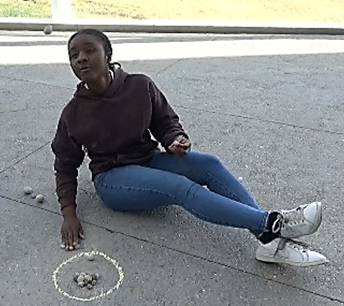
“You are supposed to take only one at a time and you can only use one hand. So, now the point of this is to take these three back in while leaving one out. With one hand, throw one and catch it. The goal of Nhodo is to get as many stones out of the circle as you can. At the end of the game when there aren’t any stones remaining in the circle, and the person that has the most stones has won”.
“In the original version of the game, you actually dig a hole in the ground. I used to play it at my grandmother's house. So, you dig a hole, and there’s no pavement anywhere. Trees are sprouting everywhere. You find a little stone. Dig a hole. It was a lot harder to get them out of the hole, and that’s how people lost. When you start playing on pavement, it’s much, much easier to do it this way because it is flat”.
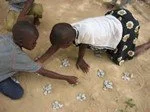
www.heraldonline.co.zw
“The funny thing is sometimes when you’re playing, and you’re like little girls and you’re very competitive. And then the one is here, and you hear people shouting, ‘line is out, line is out, line is out!’. You’re basically saying, ‘you are done, your turn is done’. But line is in”.
“It’s best to make sure that rocks have smooth surface and it doesn’t have any sharp corners, and you can throw it and catch it easily and it doesn’t hurt too much because you can feel a stone landing in your hand when you don’t want it to hurt”.
Nhodo is considered a game to be played mainly by children during their pre-adolescent years [5]. Participants were taught to sit in a crossed-legged position for reasons of dignity for females and for respect by males. This game developed rigorous thinking for cognitive development [5].
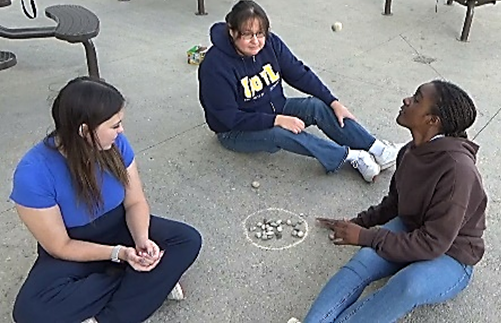
Successful mastery for playing Nhodo requires a tight sequencing of movements involving the hand-eye-limb coordination with spatial and temporal accuracy [7]. The triadic sequence of throwing, grabbing, and catching stones uses visual feedback with working memory of each successive trial using spatial awareness while enhancing movements of dexterity. Inhibition of impulsive moves are always necessary for continuous play in Nhodo.
Hopscotch (Ata-oo) Mutambo weHopscotch
Hopscotch is enjoyed by children around the world who play by drawing a grid containing a series of squares or circles or a combination of shapes in dirt or on pavement [8]. There are many variations to the game of Hopscotch with his version coming from Zimbabwe: “Ata-oo”
“The advantage of this game is to develop balance. We draw a large box with 8 squares then add two for the start box.
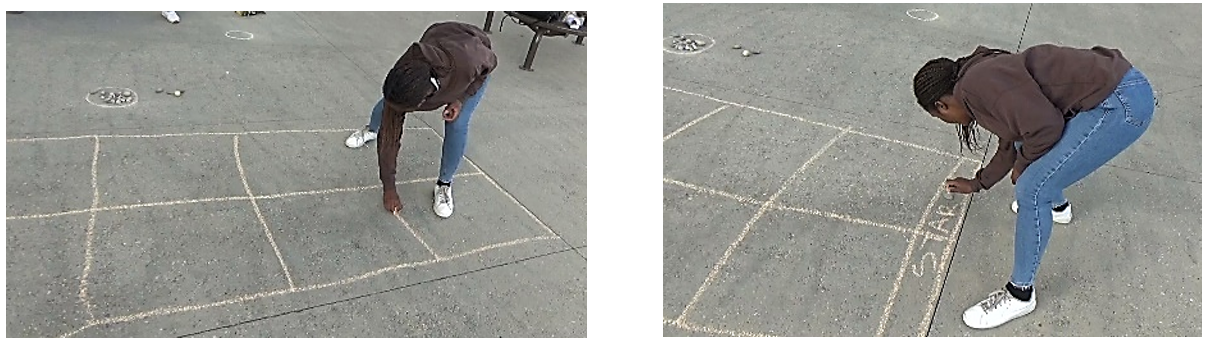
“The basic premise is to move the flat pebble into the next square and continue to the end; kicking a rock and hopping only on one foot”.
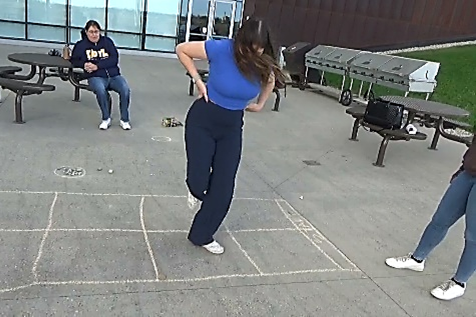
“There’s usually two people who are playing at the same time. The first person kicks the rock up the right lane to the top then skips down the other (right) lane to the end while the next player is coming up the first lane”.
On our return home we say, “Ata oodoo woo onge shop”. Then turn around again, and then as you’re going further it gets a little bit harder.
Because now that I’m in my second try I’m supposed to move it in one try to the second box. But I can’t step on the line. This is kind of tricky because it’s really, really close to the line. When you get to the end, pick up your rock, turn and make your way back jumping into each square, saying “Ata oodoo woo onge shop.”
The game of “Ata-oo” uses the adequate timing and exertion for each jump, skill to kick the rock to the next box, and re-engagement of body limbs and balance to move onto the next square.
Hopping on one foot in Hopscotch or ”Ata-oo” requires organization, and motor execution, of the spatial and temporal movement between body segments [9]. “Hopping on one leg is considered to be the most difficult form of basic jumping and is an integral part of several advanced movement skills used in games, dance, and sports [9]. Cognitive flexibility for performing various changes in movement is practiced in the games of Hopscotch as well as inhibition when considering next moves and the control for further hops and kicking stones [10,11]. Physical activities of aerobics, sports, and coordination exercises has shown to provide enhanced executive functions in school aged children with a particular emphasis in activities requiring coordination [12].
Children’s games were always included within the normal life environment of Zimbabwe and weren’t separated as Westerners understand play time. Games were always understood to sharpen children’s developing cognitive skills as well as enhance their physical literacy skills [3].
Along with the enjoyment of play, traditional games of Zimbabwe have also been considered to prepare individuals for the mental challenges in life beginning at a young age. Games are healthy means to deal with stress, as well as stay connected with family and friends, particularly while living in an age of digital games [1].
Building Brains Together graciously thanks Tadiwanashe Natasha Matemera (Natasha) for her facilitation and demonstrations of traditional games of Zimbabwe. We had a very enlightening day with Natasha as she spoke Shona along with the games. Translations were provided by Google translate and the quoted Shona language are presented as their language sounds from an English perspective.
References
Retrieved online October 2025 from: Traditional Zimbabwean Pebble Games With Western Cousins.
Cuthbertson, A. (2022). Song of the Month: Sorida - A Zimbabwean Hand Clapping Game & Welcome Song - Ashley Cuthbertson.
Clem C. (2012). Respect and hand clapping- Fundamental parts of the Shona Culture. Retrieved online November 2025 from The Villagers dot com: Respect and hand clapping- Fundamental parts of the Shona Culture- By Clem C.
Livinson, T. (2014). Traditional gams of Shona children. The Journal of Pan African Studies, 7 (4): 156-174.
Varzani, M. R. (2013). A study of the role of games in the learning improvement of elementary schoolboys in Karaj, Iran. Social and Behavioral Sciences, 84: 400-404.
Garcia, I. D., & Romero-Naranjo, Y. F. J. (2014). Hand clapping gas an educational tool: An approach to their study. In María del Mar Simón Márquez, Silvia Fernández Gea, María del Mar Molero Jurado, José Jesús Gázquez Linares, and Pablo Molina Moreno (Eds.) Innovatción Docente E Investigación En Education Y Ciencias Sociales: Desafíos De La Educatión Superior. (pg. 423-436). Retrieved online January 2026 from: (PDF) HAND CLAPPING GAMES AS AN EDUCATIONAL TOOL: AN APPROACH TO THEIR STUDY.
McKinney, K. (2012). Retrieved January 2026 from: Hopscotch Finds Its Roots in Africa | BLMTV.
Holm, I., Tveter, A.N., Fredriksen, P. M. & Vøllestad, N. (2008). A normative sample of gait and hopping on one leg papameters in children 7-12 years of age. Gait & Posture 29: 317–321.
Moreno-Montoro, MI., Martínez-Herrera, A., Soto-Moreno, E. (2023). From Head to Toe: An “Exquisite” Hopscotch as Learning and Research Through Drawing. In: Villa, D., Zuccoli, F. (eds) Proceedings of the 3rd International and Interdisciplinary Conference on Image and Imagination. IMG 2021. Lecture Notes in Networks and Systems, vol 631. Springer, Cham. https://doi.org/10.1007/978-3-031-25906-7_85.
Retrieved online January 2026 from: Building Executive Function Skills Through Games: The Power of Playful Learning | NAEYC.
Tao, Y. Zhang, Y., Qian, H., & Cao, Z. (2025). Long term effects of physical activity types on executive functions in school aged children. https://doi.org/10.1038/s41598-025-09674-9.
World Culture Encyclopedia. Retrieved January 2026 from: Culture of Zimbabwe - history, people, traditions, women, beliefs, food, customs, family, social.
Mhlanga, T. (2018). Retrieved January 2026 from: 5 Fascinating Facts About The Shona People | Rhino Africa Blog.