Building Brains Together Podcast Episode 2
The Origins of Play - Types of Play and Neurodevelopment
Episode Description:
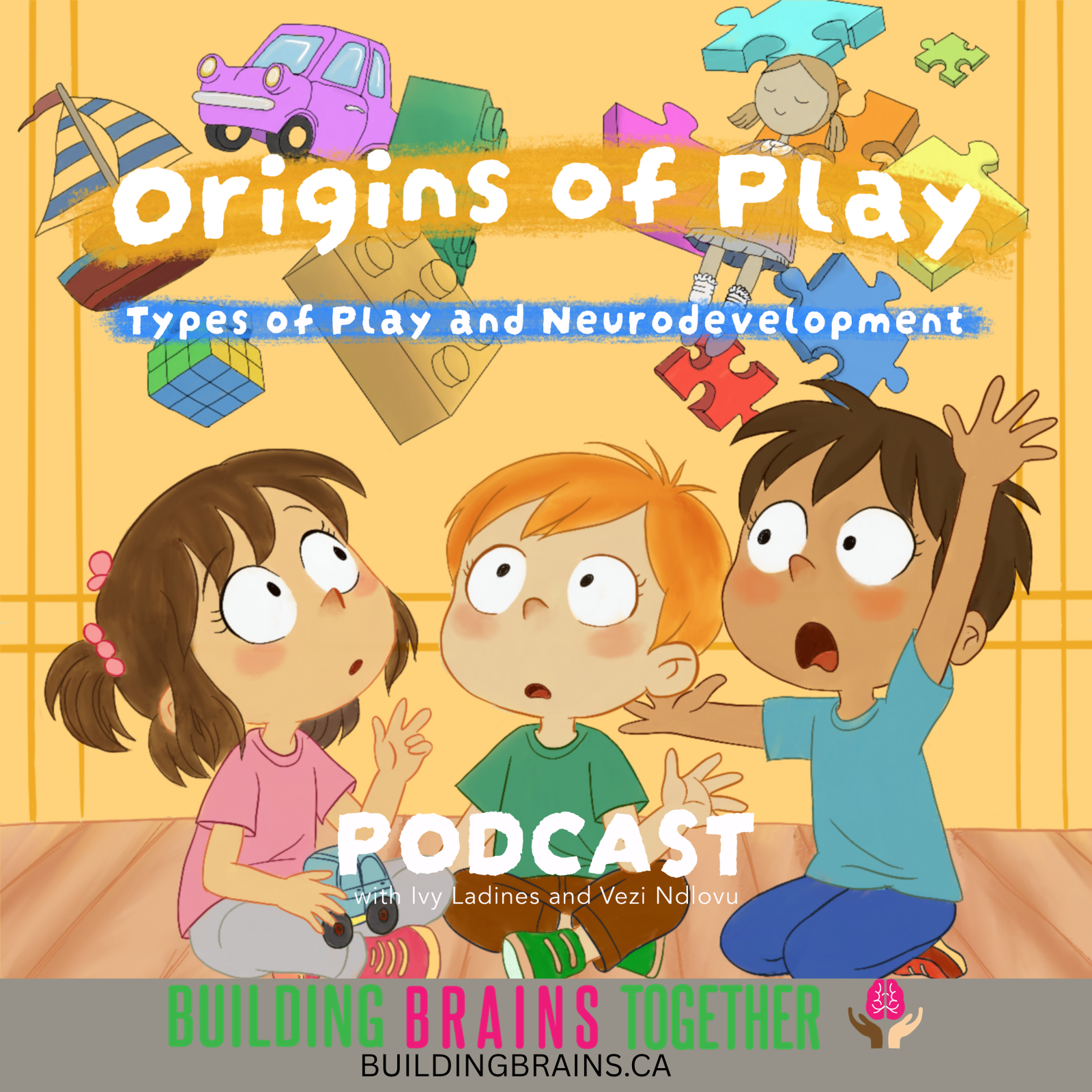
Neuroscience students at the University of Lethbridge, Ivy Ladines and Vezi Ndlovu, explore one of the biggest questions in developmental neuroscience and evolutionary biology: why does play exist at all? They discuss how researchers see play as an extension of curiosity and intrinsic exploration. The episode also breaks down the different forms of play — including pretend play, social play, object play, structured play, creative play, free play, and rough-and-tumble play — and discusses how each type supports children’s cognitive, emotional, and social development.
Three Takeaways from the Episode:
1. Play Begins with Curiosity. The world is full of uncertainty and complexity. This drives children’s natural desire to explore a novel experience, rather than just evolving to teach survival skills. In this view, play is curiosity becoming more elaborate and rewarding.
2. Different Types of Play Strengthen Different Skills. The many different types of play have an essential role in developing and reinforcing cognitive and social skills that are important later in life. Pretend play supports imagination and theory of mind. Social play helps build communication and self-control. While object and exploratory play strengthens problem-solving and causal reasoning. Structured play develops teamwork and cognitive flexibility. Creative play supports self-expression and emotional processing. Lastly, rough-and-tumble play teaches kids how to read and respond to social cues.
3. Child-led and Playful Experiences are Key. Free play is especially powerful because it gives children autonomy, motivation, and deep engagement. The quality of the experience, not just the time they spend playing, helps strengthen attention, executive function, emotional regulation, and social understanding.
References:
Raichle, M. E. (2015). The brain’s default mode network. Annual Review of Neuroscience, 38(1), 433–447. https://doi.org/10.1146/annurev-neuro-071013-014030
Song, Z., Jiang, Z., Zhang, Z., Wang, Y., Chen, Y., Tang, X., & Li, H. (2024). Evolving brain network dynamics in early childhood: Insights from modular graph metrics. NeuroImage, 297, 120740. https://doi.org/10.1016/j.neuroimage.2024.120740
Wei, Q., Zou, J., Ma, X., Xiao, X., Zhang, Y., & Shi, H. (2023). Prospective associations between various prenatal exposures to maternal psychological stress and neurodevelopment in children within 24 months after birth. Journal of Affective Disorders, 327, 101–110. https://doi.org/10.1016/j.jad.2023.01.103
Zeanah, C. H., Fox, N. A., & Nelson, C. A. (2012). The Bucharest Early Intervention Project. The Journal of Nervous and Mental Disease, 200(3), 243–247. https://doi.org/10.1097/nmd.0b013e318247d275
Hashmi, S., Vanderwert, R. E., Price, H. A., & Gerson, S. A. (2020). Exploring the benefits of doll play through neuroscience. Frontiers in Human Neuroscience, 14, 560176. https://doi.org/10.3389/fnhum.2020.560176
Iki, S. (2025). From curiosity to play: re‐evaluating the evolutionary origins of play. Biological Reviews/Biological Reviews of the Cambridge Philosophical Society, 100(4), 1467–1483. https://doi.org/10.1111/brv.70009
Cheng, D. P., Tsang, M. C., Law, P., & Tsang, A. K. (2025). The Benefits of Free Play for Children’s Attention: Implications for Teachers’ Pedagogy. Education Sciences, 15(11), 1506. https://doi.org/10.3390/educsci15111506
Liu, S., Chow, H. M., Xu, Y., Erkkinen, M. G., Swett, K. E., Eagle, M. W., Rizik- Baer, D. A., & Braun, A. R. (2012). Neural Correlates of Lyrical improvisation: An FMRI Study of Freestyle rap. Scientific Reports, 2(1), 834. https://doi.org/10.1038/srep00834