Guide to learning a language later in life
By Hailey Iwaasa, BSc Neuroscience
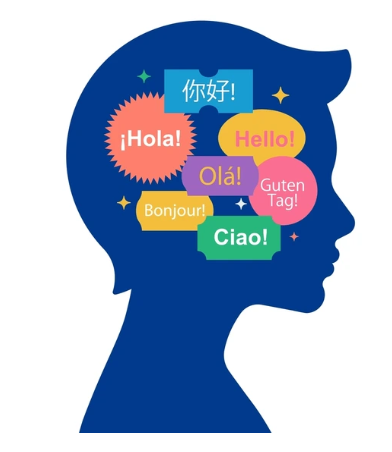
Introduction: Learning another language later in life is often compared to trying to teach an old dog a new trick. Unfortunately, it is true that it will require more time and effort than learning a new language as a young child, but it is doable. Research has found that having a second language helps maintain your cognitive abilities as you age (Ware, C., 2021). Whether it's increasing cognitive reserve, improving your executive functioning, delaying dementia (Ware, C., 2021), improving concentration or memory (Spence. C., 2022), any reason is a good reason to pick up another language. Bilingualism also offers a new realm of possible conversations and people to meet. Often the thought of learning another language can feel intimidating and time consuming, however it does not have to be that way. Through the following recommendations and tricks, anyone can start to pick up another language.
Steps for starting:
The first step to learning a language is recognizing it. The easiest way to accomplish this is music. Hearing music allows individuals to understand the rhythm and notes closely linked to speaking the language in a fun way. If you try to sing along, even if you don't understand the lyrics, it will help your future pronunciation when you start to talk in your second language.
The second step is the fundamentals. Unfortunately this is the step where traditional learning methods such as a book help immensely. You can find resources for this online, but I recommend going to your local thrift store or bookstore to find a language textbook. The goal is to understand simple words such as hello and thank you, and simple sentence structure. In English our sentence structure is “subject” - “verb” - “object”, such as “I like pizza”. However, in Japanese the sentence structure is “subject” - “object” - “verb”, so translated to english would be “I pizza like”. This is a crucial step to understand earlier in your language learning process to make it easier to speak later on.
The third step of language learning is the most fun, building that basic vocabulary. To accomplish this I recommend you to align it with your interests. For an individual learning Spanish they would switch their English hobbies to Spanish versions. If you like watching movies, turn on a Spanish speaking movie with English subtitles. If you like reading, find a book in Spanish. If you like scrolling on social media, find a creator online that speaks Spanish. If you like games, find one you can play in Spanish. The goal for this step is to start recognizing words. When I am at this step I keep my phone close to quickly search up the meaning of a word I haven't heard before. Keep in mind, this step moves slowly, there will be lots of pausing, thinking, and researching, but overtime words start to repeat and meaning gets engraved.
Now that the basics of the language are covered. It's time to understand how people put these words and sentences together in daily life, this includes phases, slang, and the difference between causal and formal discussion. One of the best recommendations for this is using podcasts. Depending on the type of content, you can hear very casual discussion to formal talk about a wide range of topics. I recommend trying to start learning new words through context clues rather than constantly searching them up. In real conversation, no matter how many years of learning there has been, people will use words you have never heard before. It's important to use the surrounding words to help fill in the gaps. Write down the word you didn't understand and what you thought the meaning could be, and then go back after and see how correct you were.
The past 4 steps will get anyone to a conversational level in the language they desire. For the fifth step I wanted to give some suggestions for the process. Firstly this is not a linear or fast process. There will be moments where you have more free time to study, moments when you have higher motivation and other times where you don't. It is important to be kind to yourselves, and allow going back to the earlier step to remind yourself of what you have already learned. When it comes to vocabulary, practice is the biggest thing. Repeating the words and their meaning may happen several times before it starts to click. Embrace your mistakes, a sentence may not make any grammatical sense, but at least you're willing to try and put words together. I have been several years into a new language and still consistently make mistakes, but they teach me about my weaker points and where my effort should be focused towards.
The final step is the overall best tip I have for learning another language, which is immersion. It may be the hardest, most intimidating way, but the results are immensely noticeable. If attainable in your current situation, take the time to travel to the country that speaks the language you are learning and just try to communicate. Naturally there will be countless mistakes and awkward silences, but those are moments where the most learning is done. The majority of the people I have interacted with love to see people try regardless of how they do. Start with interactions that don't require as much back and forth conversation such as buying an item from the store or ordering a meal. Work up the confidence to try and have harder more complex conversations until it feels almost natural to talk in the other language. If travel isn't an option, find someone in your local community that is either from a country that speaks that language or learned it. Not only will you benefit immensely from the social aspect, but you will improve communication in your second language, and most importantly confidence in speaking it.
Conclusion: Once you are happy with progress in your second language, don't forget that there are over 7000 different languages out there, which means billions of people with something to say. Why not give learning more a try?
References:
Ware, C., Dautricourt, S., Gonneaud, J., & Chételat, G. (2021). Does Second Language Learning Promote Neuroplasticity in Aging? A Systematic Review of Cognitive and Neuroimaging Studies. Frontiers in aging neuroscience, 13, 706672. https://doi.org/10.3389/fnagi.2021.706672
Van der Ploeg, M., Keijzer, M., & Lowie, W. (2023). Language learning, motivation, and well-being in later life. Social Sciences and Humanities Open, 8(1), 100749. https://doi.org/10.1016/j.ssaho.2023.100749
University of Chicago Wisdom Research Center. Why it’s never too late to learn a language as an adult. Retrieved online June 2026. https://wisdomcenter.uchicago.edu/news/wisdom-news/why-its-never-too-late-learn-language-adult
Cambridge University Press. (2022). Learning a language changes your brain. Retrieved online June 2026. https://www.cambridge.org/elt/blog/2022/04/29/learning-language-changes-your-brain
Cambridge School. How music can help you learn a new language. Retrieved online June 2026. https://www.cambridgeschool.com/en/how-music-can-help-you-learn-a-new-language-eng.html
Shutterstock stock image. Retrieved online June 2026. https://www.shutterstock.com/search/child-learning-language?image_type=illustration